
Leicht vs Next125: how to choose
Both are premium German kitchens and both are beautifully made, so the choice comes down to character. This is how we help clients decide between them.
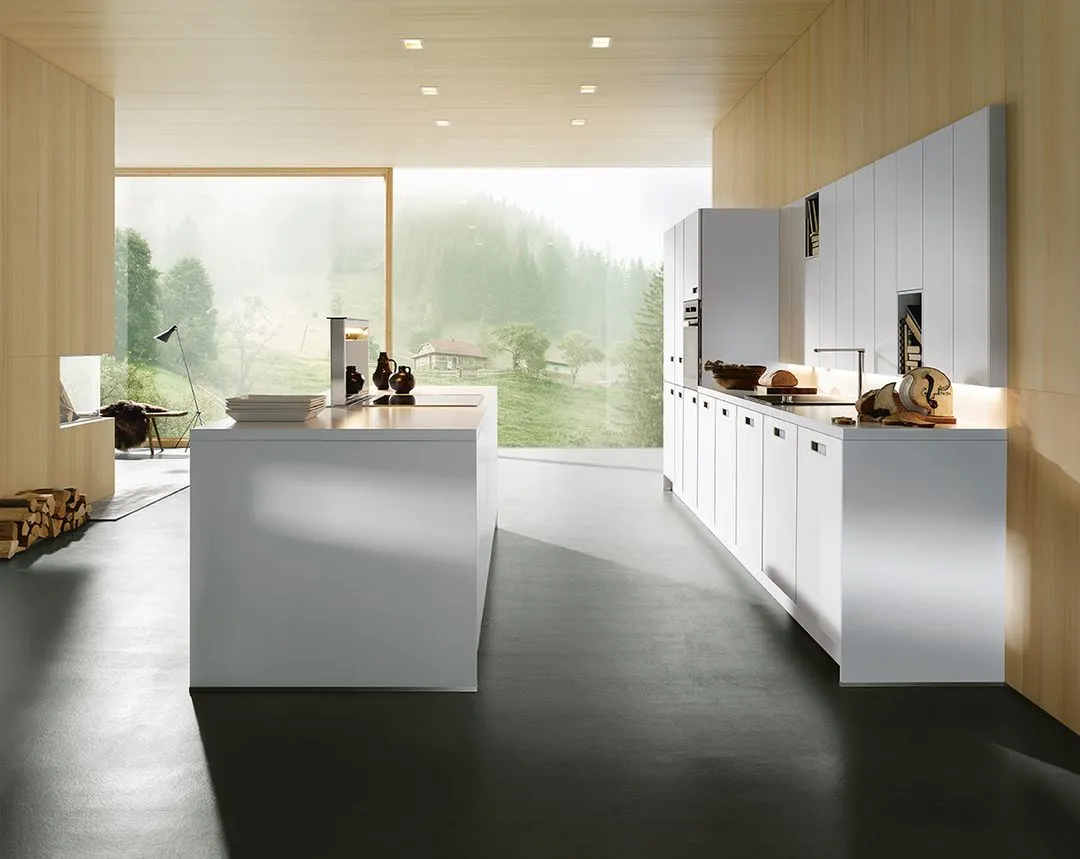
We are asked to compare Leicht and Next125 more than any other pair of ranges, and it is easy to see why. Both are German, both are made to order with the tight tolerances and engineered hardware that phrase implies, and both sit at the upper end of what we offer. On a specification sheet they can look very similar. In a room they feel quite different.
The short version
Leicht is the more architectural of the two. It works in disciplined lines and a materials palette that leans on natural timber, matt lacquers and textured surfaces, and it is comfortable moving between contemporary and warmer, more classic schemes.
Next125 is the more sculptural. It is built around broad, uninterrupted planes of ceramic, glass, lacquer and fine timber, with handleless operation and integrated lighting as part of the system rather than an add-on. It looks more like a piece of modern furniture than a run of fitted cabinets.
Design language
Leicht's strength is quiet structure. Runs of cabinetry line up cleanly, storage disappears behind flat fronts or slim framed doors, and the whole thing feels considered without drawing attention to itself. If you want a kitchen that supports the architecture of the room rather than competing with it, Leicht tends to be the natural fit.
Next125 makes more of a statement. Its fronts are often thicker and more material-led, its islands read as single monolithic blocks, and pocket-door zones and tall runs resolve with minimal sightlines. It suits open-plan spaces where the kitchen is the centrepiece and where you want the furniture itself to carry the design.
Materials and finishes
| Leicht | Next125 | |
|---|---|---|
| Signature surfaces | Natural woods, matt lacquers, textured and framed fronts | Ceramic, glass, lacquer and fine timber in large planes |
| Character | Architectural, warm, adaptable | Precise, sculptural, furniture-like |
| Handleless | Available across the range | Central to the system |
| Best suited to | Homes that want calm structure across classic to contemporary schemes | Open-plan spaces where the kitchen is the focal point |
Storage and everyday use
This is where the two are closest. Both use engineered drawer and hinge systems built for quiet, repeatable daily use, and both offer deep internal organisation, tall larder solutions and corner storage that actually works. Neither will let you down on function, so we would not choose between them on this basis.
Budget
Next125's material programme places it a little above Leicht in most specifications, though the overlap is wide and a heavily specified Leicht kitchen can cost more than a simpler Next125. If you are weighing the two, it is worth reading our guide to what shapes the cost of a German kitchen.
We always recommend seeing them side by side. The difference between a Leicht timber front and a Next125 ceramic front is obvious in seconds when you can touch both, and impossible to convey on a screen.
How we help you decide
At a design consultation we start with the room and how you live in it, not the brand. Once the layout is right we will usually show you how it looks in both ranges, and the decision tends to make itself. Both Leicht and Next125 displays are in our Saddleworth showroom, with working appliances and a full materials library.