
German or in-frame: which suits your house?
Start with the house, not the kitchen. A German kitchen suits rooms that want clean lines and storage that works hard. Painted in-frame suits rooms that want furniture with some weight to it.
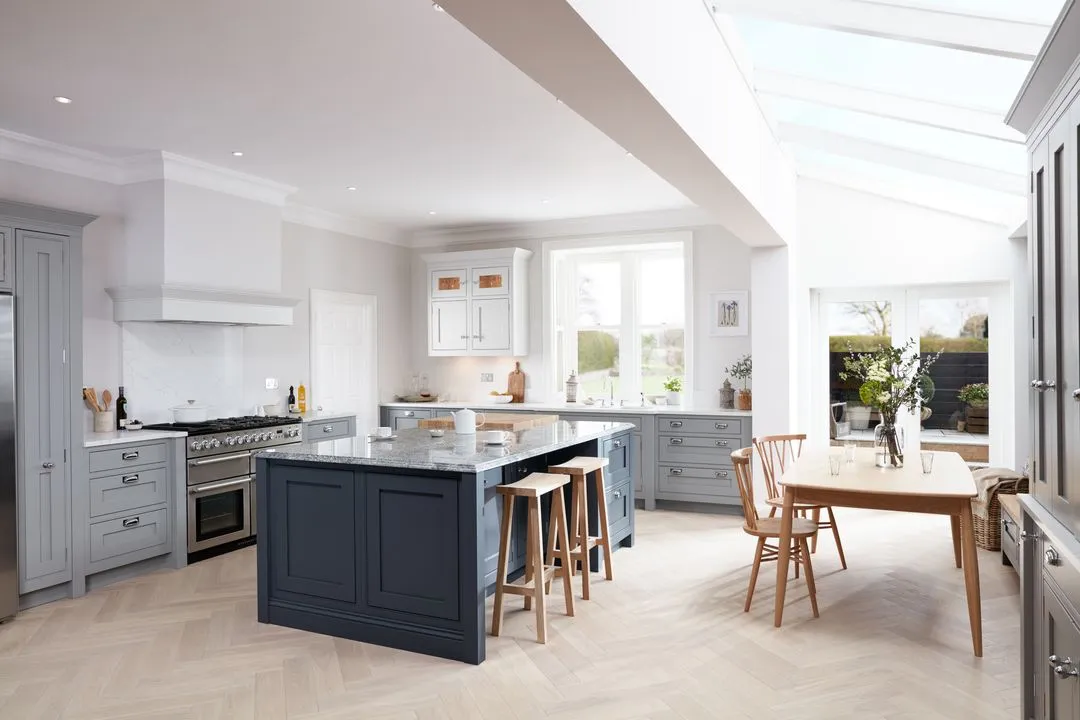
We show both under one roof on Uppermill High Street: German kitchens from Leicht, Next125 and Schüller, and painted in-frame from 1909 and Novelle. So there's no need to pick a side before you come in. Here's how we'd think it through.
What the two actually are
A German kitchen is built on a modular system. Most are slab-fronted, opened by a grip ledge, push-to-open or a handle. Finishes run from matt lacquer and veneer to ceramic and real glass.
The system is the point. Next125 plans everything on a 125 mm grid, where one grid unit is one drawer height. It's why the lines run true from one end of the room to the other.
An in-frame kitchen is built the traditional way. The door sits inside a timber frame that's part of the cabinet, so you see the frame around every door and drawer. 1909 makes its painted cabinetry in County Durham, with alder on the outside and 35 colours to choose from. Novelle's is made to order in Buncrana, County Donegal.
When German tends to suit
- Open-plan rooms and extensions. The kitchen becomes part of the living space, and a quiet run of slab fronts lets the room breathe.
- Storage that has to earn its place. Tall runs, internal drawers and pull-outs are what these systems are built around.
- Finishes you can't paint. Ceramic, glass, linoleum and veneer fronts are all part of the Next125 programme.
When in-frame tends to suit
- Period houses. In a Saddleworth stone cottage or a Victorian terrace, a painted frame usually sits more comfortably than a long handleless run.
- A kitchen that should feel like furniture. Dressers, larders and 1909's solid timber dovetail drawers in washed oak all lean this way.
- Colour. 1909 paints in 35 colours, and Novelle can colour match. If there's a shade you already live with, in-frame will carry it.
Where it could go either way
Plenty of houses sit in the middle. Take a 1930s semi with a new rear extension. You could run a German kitchen through the extension and let it read as new work. Or you could carry an in-frame kitchen into it, so the room feels like it's always been there.
Neither is wrong, and the ranges overlap more than people expect. Leicht's WAKUU fronts have narrow 10 mm frames in wood or lacquer, a German kitchen with a hint of the framed look. And 1909 makes slab doors, Slab Portal and Slab Extended Channel among them, for a quieter door in a traditional build.
Time and cost
Both routes are made to order. Lead times vary by manufacturer and time of year, so we confirm a realistic delivery date when the order goes in.
Neither has a fixed price either. What moves the figure is the size of the room, the finish, the worktops and the appliances. At consultation we plan the kitchen properly and give you an itemised figure for the whole project, installation included. There's more on that in what a German kitchen costs.
See them side by side
It's far easier to decide in front of the real thing. Our showroom at 119–121 High Street, Uppermill, has full displays, working appliances and a materials library. You're welcome to call in, or to book a one-to-one consultation and talk it through.